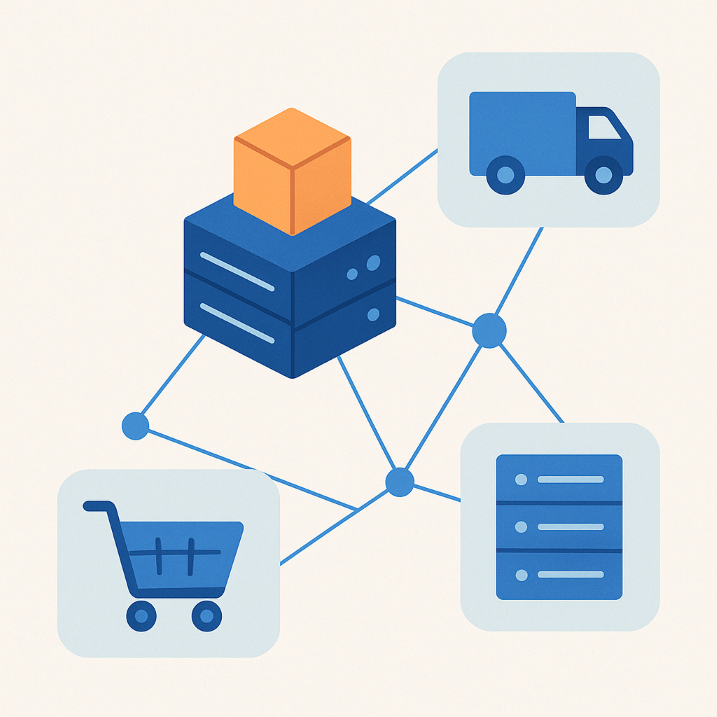
1. Introduction: Why Talk About Product Upload via API at All
API integrations in e-commerce are not new nor a trend of the last decade. They have always existed. The difference lies elsewhere: previously, API was more of a convenient but optional way to transfer data, whereas today many companies work with it out of necessity — simply because their suppliers or partners don't offer other options.
Suppliers often provide only one format of interaction — the one they managed to implement themselves. Some provide data exclusively via API. Others — only via file. Some use their own custom format, invented ten years ago. And not because it's the best standard, but because they simply lack the resources, expertise, or budget to support multiple integration technologies.
As a result, the market finds itself in a paradoxical situation: there is plenty of technological diversity, but very few options for data exchange. Online stores have to adapt: if a supplier works only via API, then a separate integration must be developed.
And here a key conflict arises. API indeed offers flexibility and control: you can choose the update frequency, data volume, and manage the process from your side. But at the same time, every new API is unique. There are no universal connectors, no standard, and each integration is a separate development, testing, documentation, and inevitable surprises.
API is convenient when dealing with one supplier. But at scale, it turns into a complex, constantly updated environment: versions change, fields disappear, data behaves unpredictably. This is the real life with API in e-commerce.
2. Why a Business Might Need Product Upload via API
To be honest, in most cases, the business doesn't care at all how it receives data: via API, file, email, or manually. The goal is always the same — to get product information as easily, quickly, and painlessly as possible.
This is precisely why the word "API" itself should not be perceived as a strategic value. It is merely one method of data delivery, and far from the simplest one. The main task of the business is not to connect to an API, but to correctly process, organize, and integrate the data into its system.
There is a common illusion: that API automatically provides more flexibility and allows for better control over data transformation. This opinion is often held by technical specialists because API is associated with structured, clean, and predictable data. In practice, however, what matters is not "through which channel the data arrived," but what that data is.
Sometimes API can indeed deliver a more detailed structure. But the richer the structure, the more complex its processing on the store's side. And if a file dump provides minimal information, API sometimes brings a maximum, even to the point of overloading the system with redundant parameters.
There is another problem: API is very often used not only for transferring product content but also for exchanging orders, stock levels, statuses, and settlements. This makes integration more expensive to develop and significantly more complex to support.
Meanwhile, many stores live perfectly well on ordinary file-based feeds and do not experience any limitations from this.
Summary: API is useful, but it's an expensive tool. It only reveals itself in the hands of a team that knows how to work with it professionally. In all other cases, API turns not into an accelerator, but a source of unnecessary complexity and hassle.
4. Difficulties in Working with API Integrations
Working via API seems simple only in theory. In practice, it is one of the most resource-intensive and conflict-prone integration formats in e-commerce. The main difficulty lies in the fact that API requires constant technical support from both sides — both from the data provider and the data receiver.
The first problem is the need for a full-fledged IT team. You cannot "connect an API once and forget about it." Documentation changes, versions are updated, fields disappear or appear, servers go down, update logic changes. And all this requires ongoing supported development. Attempts to outsource this usually fail: the integrator is not part of the business and sooner or later stops supporting your integration. This means your business becomes hostage to an external team.
The second problem is the misalignment of business processes. Often, the supplier's API simply does not match how data lives inside the store. One supplier updates prices five times a day, another — once a week. One has a full set of attributes, another — three mandatory fields. And it's the store that is forced to "bend" to this logic, adapting its data structure to someone else's API.
The third problem is that file-based integrations are much more stable. File exchange is a basic market mechanism, familiar to everyone, working for decades, and supported by even the simplest CMS. But API gives too much freedom for interpretation: every developer has their own views, standards, and ideas about product structure. Hence the endless variety of logics, formats, and errors.
The fourth problem is identifiers and relationships. API almost always works via ID linkages: product → order → status → stock. And if you have three to five suppliers, each with its own identifier model, entity architecture, and catalog philosophy, the store is forced to maintain a separate storage and mapping layer for each. This is expensive, complex, and constantly breaks.
The fifth problem is that API binds companies too tightly. Integration becomes an important infrastructural part of the relationship. And if something fails, the consequences immediately hit the business. The risks are low in probability but extremely painful in effect. Therefore, stores often continue to support complex integrations for years, just to minimize the risk of process stoppage.
Another technical nuance adds to this: API is more sensitive to failures than files. If a file can be "sent tomorrow," an API failure can stop stock synchronization, disrupt order exchange, or lead to incorrect statuses. Problems that in a file-based model are solved with minimal manual adjustment can escalate into full-blown incidents with API.
5. Is It Possible to Manage Without API: Alternative Data Sources
The question "is it possible to manage without API" sounds logical only on paper. In the real work of stores and suppliers, this question most often makes no sense because there simply is no choice. The supplier provides data the way they provide it. And if it's only API — then you will work via API. If they only have a file — you will have to work with the file. There are very few situations on the market where a store can actually choose the format.
But where a choice does exist, it's important to understand the difference and not fall into the false dilemma of "API or file." In practice, the optimal solution is almost always a symbiosis.
For the product matrix — long, heavy, stable data — file exchange remains the most natural and reliable method. All systems, from simple CMS to large corporate solutions, have been working with files for decades. The file channel is easy to maintain, cheaper to develop, and requires almost no support. If the supplier's product files are in good condition — there is no point in complicating your life with API.
But data that needs to be updated promptly and accurately — orders, stock levels, statuses, sometimes prices — is logical to transmit via API. Here, API indeed provides an advantage: data arrives at the moment it is needed, not when the supplier generated a new file.
Therefore, when there is a choice, the recommendation looks like this:
- Product matrix, attributes, slow-changing content → file. More reliable, simpler, and cheaper.
- Stock levels, orders, statuses, fast-changing data → API. Speed is important here.
Summary: the question "managing without API" is incorrect. It is more correct to think about how to divide data by type and choose the optimal channel for each type.
6. Resources Needed to Work with API
The main resource, without which it is impossible to build a sustainable API integration, is developers. And not contractors "on the side," but your own in-house team or at least one technical specialist within the company. API is not a one-time task, but a constant maintenance process. Outsourcing it to an external partner means essentially handing over control of part of your own operational model to an external party. At a critical moment, the contractor may leave, refuse support, or simply not respond in time — and the business will virtually stop.
An in-house developer can also quit, but unlike an external performer, they are under the company's management, understand the business context, participate in processes, and remain part of the internal infrastructure. This reduces risks and ensures stability.
Resources also include:
- Costs for support and maintenance. API changes, evolves, loses old fields, gains new ones. You need to constantly adapt.
- A team that knows how to work with data. Even the most correct API delivers "raw" data that still needs to be integrated into the catalog, CMS structure, and business processes.
- Organizational readiness. API enhances interdependence between companies. If your partner changes the API structure — you are obliged to react.
- Internal data control processes. Often, API brings too many parameters that the store must interpret, validate, and supplement.
If a company does not have its own technical team, no allocated budget, and no experience in supporting integrations, then the question should sound different: do you really need API? For a small store, this can be an excessive risk and unjustified burden. Sometimes it's easier to find another supplier or another integration format than to support an expensive and fragile API connection for years.
If the business is growing and API is becoming part of its future strategy, then the costs for a team and infrastructure can be considered an investment in scaling.
7. API Connection and Data Post-Processing
Getting the data is only the first step. This is where the magic of API ends and the real work begins. It doesn't matter how the content was obtained: via API, through a file, via email, or manually. Only one thing is important: what to do with it now.
For every online store, regardless of scale, the main problem remains the same: the content needs to be processed, cleaned, brought into structure, distributed across the catalog, matched with existing products, supplemented with attributes, relationships, and images. API does not reduce this load in any way. Sometimes, on the contrary, it increases it.
The larger the store, the more partners, more connections, more responsibility, and more data volumes. The old approaches of "fixing a little by hand" stop working. The content becomes heavy, heterogeneous, contradictory. API delivers data faster, but does not make it better.
This is precisely why API integration itself does not solve the content problem. It only delivers the data. Everything else — validation, normalization, merging duplicates, translating attributes into a unified format, building horizontal relationships — remains on the store's side.
This is the key transition to the next section about the role of NotPIM: the store needs not a data transmission channel, but a system that can turn this data into finished product content.
9. The Role of NotPIM in This Process
NotPIM occupies a special place in the chain of API integrations. We do not compete with API connections nor try to replace them. We solve the part of the task that actually creates value for the store: processing, normalizing, and preparing content after it is received.
NotPIM can work with API sources as naturally as with files. We already have ready-connected partners, and we know how to support such integrations long-term. If a store receives data via API from a supplier, we accept this stream on our side, parse it, organize it, validate it, and turn it into structured content convenient for further work.
After processing, the store receives the data in the form that is convenient for it: with its attribute structure, with its catalog, in the desired format and with the desired update frequency. We can output data once a day, or every 10 minutes — it all depends on which mode is optimal for the store's load and internal processes. Essentially, NotPIM becomes a layer that removes all the complexity of the API source from the store.
It is important to emphasize that NotPIM is a content system, not a settlement or order management system. We are responsible for product content: its correctness, cleanliness, matching, and enrichment. Exchanging orders, statuses, stock levels — these are the areas of responsibility of the store and its partners. But if a client requires API integration with a specific supplier, we can implement it as an additional service. If the store needs such a project — it's enough to just write to us, and we will take it on.
10. Conclusion
API is neither good nor bad. It is merely a method of data transfer that is shaped not by the store's desire, but by market circumstances. If a supplier works only via API — you will work via API. If they provide only files — you will live on files. A single store cannot change the market, its standards, the technical maturity of suppliers, or their internal limitations.
Therefore, the question is not "whether API is needed," but what to do with the data after you receive it. API does not solve the quality problem, does not eliminate the chaos of attributes, does not simplify cataloging, and does not relieve the responsibility for maintaining the data structure.
This is where the mission of NotPIM begins. We remove the barrier between the two market participants. We accept data in any form — via API, by file, by link, from several sources simultaneously — and turn it into meaningful, structured, clean content ready to work in the store's system. We ensure that the method of data transfer ceases to be a problem and ceases to impose its limitations on the store.
The market can be fragmented, complex, and diverse. But with the advent of NotPIM, stores get a real tool that relieves the technical tension between companies and allows them to focus on the main thing — content quality and business efficiency.