From Manufacturer to Consumer
Content matters.
This is not a services page. This is an explanation of why the project was created, what problem it solves at the market level, and why we chose this specific path.
Why NotPIM was created?
NotPIM emerged from practical observation of the e-commerce market. We noticed that regardless of business scale—whether a local shop or an international distributor—companies face the same fundamental issue.
It is the gap between product manufacturing and the end consumer. This gap is not formed by logistics, price, or marketing. It is formed by information.
Market Asymmetry
Modern e-commerce is built on data, but access to it is unevenly distributed.
Fragmentation
Data is scattered. It's inconsistent, often inaccessible, and locked away in proprietary systems. The buyer rarely sees the full picture.
Technical Barrier
Large players build proprietary standards. Small businesses are excluded due to the high barrier to entry for technology.
Inequality
Technology amplifies those who already possess it. The market becomes asymmetric, stifling competition based on product quality.
To lower the barrier between production and the buyer.
We believe the buyer has the right to complete, truthful, and comparable information. A transparent market reduces overproduction, encourages quality products, and lessens dependence on closed ecosystems.
Why a single standard is impossible
We understand that unified data exchange standardization in e-commerce is a utopia. Industries, processes, and historical constraints are too diverse.
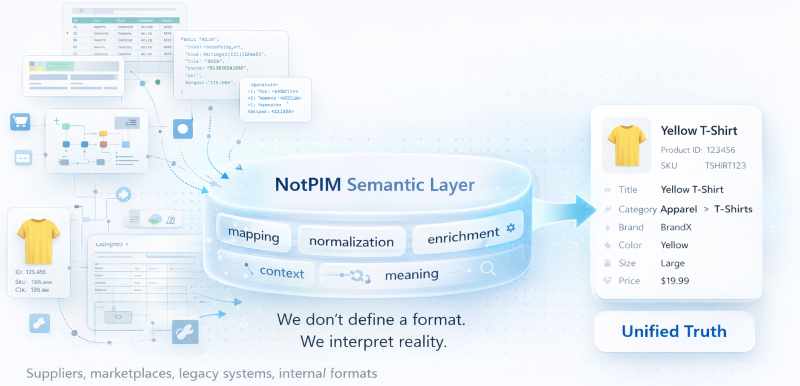
Therefore, our goal is not to impose a new format that no one will support. Our goal is to create technologies capable of working with reality.
NotPIM is not a protocol. It is a knowledge hub that accepts data in any form and brings it to meaning.
Operating Principles
🏗 Content as Infrastructure
Access to quality product information should not depend on a company's IT budget. We are building infrastructure accessible to all market participants—from garage manufacturers to large holdings.
🔌 Without Changing Processes
We do not force businesses to change their development vector. We integrate into the existing infrastructure where necessary.
AI as an Equalizer
AI and automation are not the end goal. They are the tools that allow a small team to accomplish the work of an entire department.
Ecosystem Impact
Brand representation control and reduced time-to-market.
Lower content management costs and enriched catalogs.
Understanding what they are buying and the ability to compare.
Do you share our values?
We are open to dialogue with those who view the market the same way we do.
Collaboration
Building a similar product or looking to join forces? Let's form an alliance.
Become a Partner